


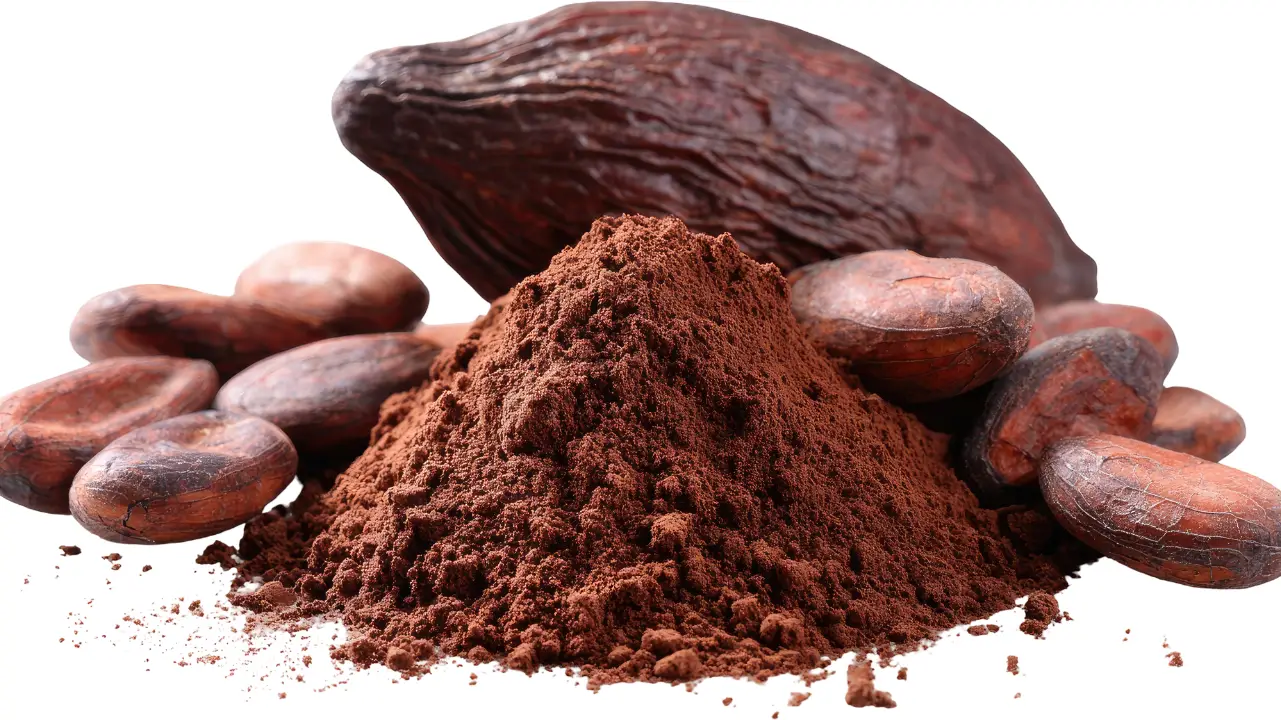

When a business plans to launch a cocoa product under its own brand, one of the first questions is whether to invest in its own production facility or work with a cocoa powder OEM manufacturing partner.
There is no single answer that applies to every business. However, OEM becomes a practical option when the cost of in-house production, technical barriers, and operational risks outweigh the benefits the company can realistically control.
This article examines specific situations to help importers, distributors, and F&B businesses decide whether OEM or in-house manufacturing is the more appropriate model.
What Is Cocoa Powder OEM Manufacturing and How Does It Work?
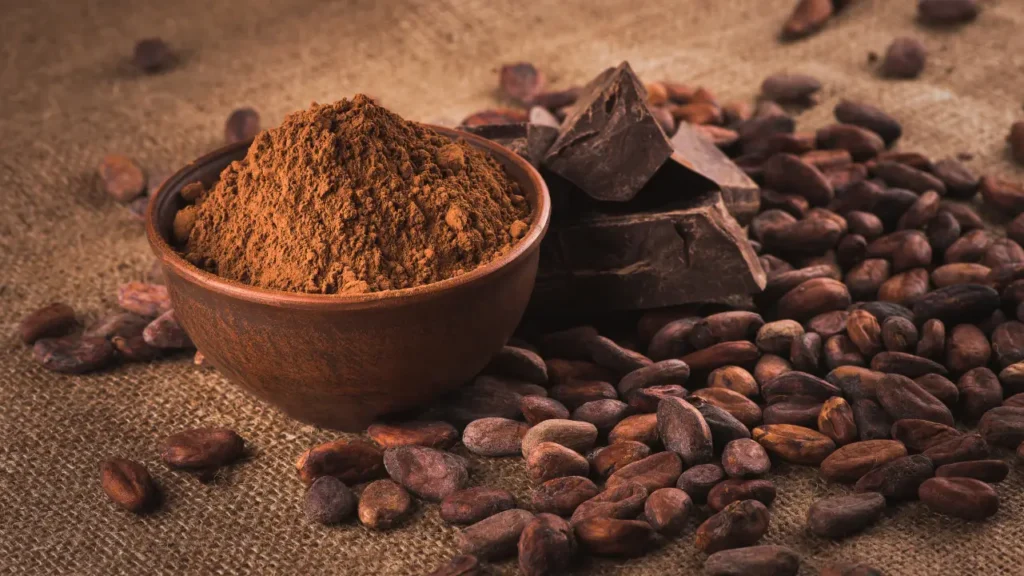
Cocoa powder manufacturing is a model in which a business works with an established processing facility to produce cocoa powder according to its requested formula, specifications, and packaging requirements.
The finished product can then be sold under the buyer’s own brand. This approach is often associated with private label cocoa products.
A typical cocoa OEM process includes several key stages:
- Requirement consultation: The business provides specifications for flavor, fineness, cocoa butter content, alkalization level if applicable, packaging type, and pack size.
- Sample development: The manufacturer produces laboratory-scale samples for sensory evaluation and formula adjustments.
- Product documentation: Regulatory and quality documentation is prepared according to applicable requirements.
- Mass production and cocoa packaging: The factory produces the approved batch and performs finished-product quality checks.
- Finished-product delivery: Products may be delivered as semi-finished goods or fully packaged products ready for distribution.
The main difference from in-house production is that the business does not need to invest directly in machinery, factory facilities, production staff, and quality-management systems.
Instead, it can focus its resources on brand development, distribution channels, sales, and customer service.
Another important point is that cocoa powder OEM manufacturing is not simply about renting production equipment.
Businesses are also accessing the manufacturer’s operational capabilities, problem-solving experience, and quality-control systems developed through previous production runs.
The real value lies in maintaining consistent quality between batches, something that can be difficult for a newly established production facility during its early stages.
When Should You Choose Cocoa OEM Manufacturing Instead of In-House Production?
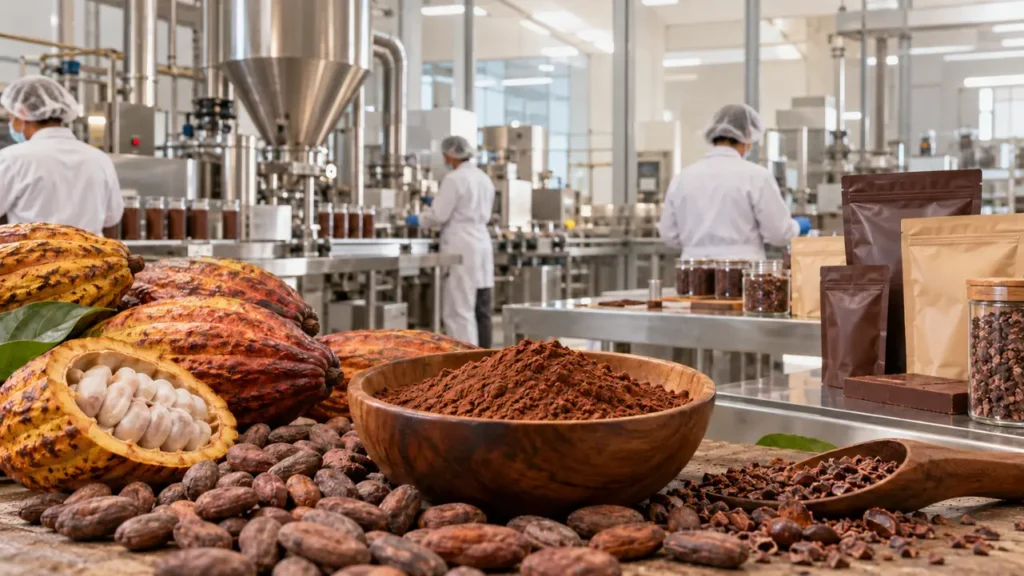
The decision between OEM and in-house manufacturing should not be based on assumptions alone.
There are several situations in which outsourcing may be the more practical option.
Your Business Does Not Have a Factory and Wants to Test the Market
For a company entering the food industry or a distributor expanding into cocoa powder, investing heavily in roasting, grinding, cocoa butter pressing, and packaging equipment may not be practical.
A cocoa processing facility may require investment in:
- Cocoa roasting and sterilization systems
- Industrial fine-grinding equipment
- Alkalization systems for alkalized cocoa powder
- Automated packaging equipment
- Raw-material storage facilities
- Dust-control and microbiological-control systems
By choosing cocoa powder OEM manufacturing, a business can begin with lower working-capital requirements and potentially reduce the time needed to bring a product to market.
More importantly, during the market-testing stage, businesses may not yet know which products will perform best.
OEM manufacturing makes it possible to test different formulas and cocoa packaging formats before deciding which products should become core SKUs.
Order Volume Is Not Large Enough to Offset Fixed Costs
In-house production generally becomes more efficient when factory capacity is utilized consistently.
If a business only requires a relatively limited volume of cocoa powder each month, equipment depreciation, labor, maintenance, and quality-management costs can significantly increase the cost per kilogram.
A professional cocoa OEM manufacturer may serve several customers at the same time, allowing fixed operating costs to be distributed across a larger production volume.
As a result, outsourced production may offer a more efficient cost structure than operating a small facility below its designed capacity.
The break-even point depends on product type, level of automation, labor costs, and production volume.
For many small and medium-sized businesses, actual demand may remain below that threshold during the early stages of market development.
Technical and Processing Requirements Are Complex
Not every type of cocoa powder has the same manufacturing requirements.
Some products require specialized equipment and processing expertise.
Alkalized Cocoa Powder
Alkalized cocoa powder is treated with an alkaline solution to reduce acidity and modify its color and flavor.
Factors such as alkali concentration, temperature, and processing time can directly affect the characteristics of the finished product.
Fine Cocoa Powder
Some applications require specialized grinding equipment to achieve specific particle-size requirements, particularly for beverage and food-processing applications.
Chocolate Beverage Powder
Chocolate beverage powder may combine cocoa powder with sugar, milk powder, emulsifiers, or other ingredients according to a defined formulation.
Consistent blending and moisture control are important to achieve uniform product quality.
For these types of products, the accumulated technical experience of an OEM manufacturer can be difficult to develop internally within a short period.
Even with suitable equipment, production parameters may require repeated trials and adjustments before the desired flavor profile, color, texture, and performance are achieved.
Working with an experienced cocoa powder manufacturer allows businesses to access established production expertise from the beginning.
Your Business Needs Certifications and Regulatory Documentation
Businesses selling cocoa products need to consider the regulatory requirements of their target market.
For export markets, requirements may involve:
- U.S. FDA regulations
- EU requirements for heavy metals and pesticide residues
- HACCP
- ISO 22000
- Halal
- Kosher
- Market-specific labeling and food-safety requirements
An experienced cocoa manufacturer may already have quality-management systems and technical documentation related to its raw materials and production processes.
This can help businesses prepare documentation for new SKUs more efficiently.
For companies exporting food products to the United States, you can also review the FDA’s Foreign Supplier Verification Programs requirements to better understand the responsibilities of importers supplying food to the U.S. market.
Your Business Wants to Focus on Branding and Distribution
For many F&B businesses, the main competitive advantage does not necessarily come from manufacturing.
Instead, it may come from understanding consumers, building a brand, and developing strong sales and distribution channels.
A coffee chain that wants to launch cocoa powder under its own brand does not necessarily need to become an expert in operating industrial grinding equipment.
What it needs is consistent product quality, suitable packaging, and reliable supply.
In this situation, working with a private label cocoa powder manufacturer or a manufacturer of instant cocoa and chocolate beverage powders allows the business to focus more resources on marketing, sales, distribution, and customer experience.
These activities may contribute more directly to the brand’s commercial growth than managing an entire production line internally.
Businesses can therefore concentrate their investment on the areas that create the strongest competitive differentiation instead of spreading resources across too many operational functions.
Product Demand Changes Over Time
Demand for cocoa products can vary depending on the product category, season, market, and sales channel.
Hot cocoa beverages may experience stronger demand during colder periods and festive seasons, while cocoa-based cold drinks can perform differently during warmer periods.
With in-house manufacturing, a business must maintain machinery, production staff, and facility costs throughout the year even when demand fluctuates.
With an OEM model, production volumes can be adjusted according to actual requirements, subject to the manufacturer’s MOQ and production schedule.
This flexibility can also help businesses respond more quickly when demand unexpectedly increases without immediately investing in additional manufacturing capacity.
When Is In-House Cocoa Powder Production a Better Choice?
To make a balanced decision, businesses should also understand when in-house manufacturing may be more appropriate.
- Production Volume Is Stable and Sufficiently Large
If a business has consistently high demand over a long period, investing in its own factory may become more financially viable.
Higher utilization rates can help spread equipment and fixed operating costs across a larger production volume.
- Proprietary Formulas Are a Core Business Asset
If a proprietary manufacturing process or formula represents a major competitive advantage, a company may prefer to keep production entirely in-house.
This can reduce the need to share sensitive technical information with third-party manufacturers.
- Full Production Control Is Required
Some premium brands want to control the entire process from cocoa raw materials to finished products.
In-house production can provide greater operational control and support a particular brand or sourcing strategy.
- Existing Production Facilities Are Already Available
Businesses that already operate food-processing facilities may be able to utilize existing buildings, employees, quality-management systems, and supporting infrastructure.
This can significantly change the financial comparison between OEM and in-house manufacturing.
In practice, some businesses use a hybrid model.
They manufacture high-volume core products internally while outsourcing newer products, smaller-volume SKUs, or products requiring specialized processing technology.
This approach can combine cost efficiency for core products with greater flexibility when testing new opportunities.
Common Mistakes When Outsourcing Cocoa Powder Manufacturing
Businesses working with an OEM manufacturer for the first time may encounter several avoidable problems.
- Choosing a supplier based only on price: A lower price may be associated with differences in raw-material quality, production control, or service requirements, potentially creating additional costs later.
- Failing to define acceptance criteria: Without clear specifications for moisture, particle size, color, flavor, and other product characteristics, disagreements may occur when finished products are delivered.
- Ignoring regulatory requirements: Incorrect labels or non-compliant documentation may create problems during distribution or customs clearance.
- Ordering an excessively large MOQ from the beginning: Committing to too much inventory before validating market demand can create significant cash-flow pressure.
- Having no backup supply plan: Depending entirely on one manufacturer can leave a business vulnerable if the supplier experiences production, raw-material, or logistics disruptions.
A practical way to reduce these risks is to prepare a detailed agreement, maintain an approved reference sample for comparison, and establish clear product specifications before commercial production begins.
Conclusion
The decision between cocoa powder OEM manufacturing and in-house production depends on production volume, technical capabilities, regulatory requirements, available capital, and the long-term strategy of each business.
OEM may be a practical option when production volume is still developing, processing requirements are complex, faster market entry is important, or the business wants to focus its resources on branding and distribution.
In-house manufacturing may be more suitable when demand is consistently high, proprietary formulations are a core business asset, and the company already has the technical and operational capabilities needed to manage production.
Some businesses may also combine both models by manufacturing core products internally while outsourcing newer products or smaller-volume SKUs.
Regardless of the model selected, the decision should be based on actual business data rather than assumptions.
VILIFA works with B2B requirements related to cocoa, cocoa powder, OEM, and Private Label. Businesses can contact VILIFA to discuss product requirements, specifications, packaging options, expected order volumes, and potential cooperation models.